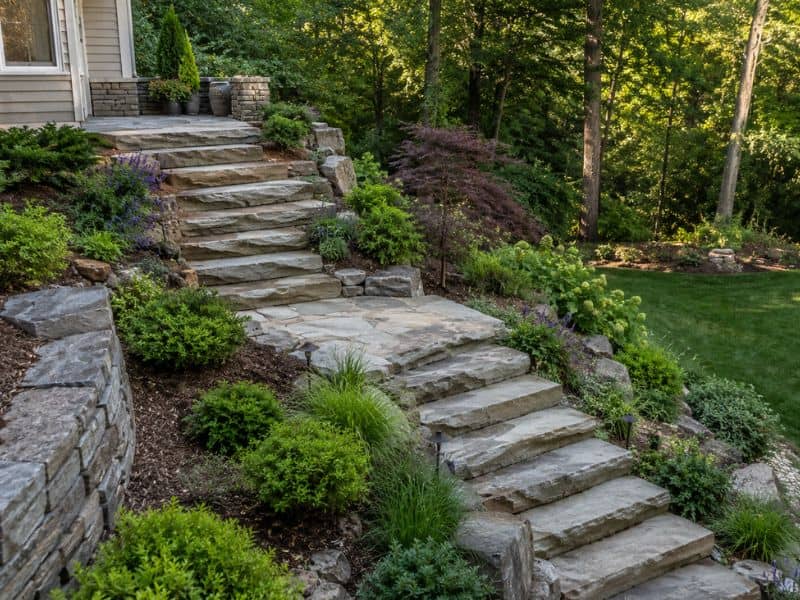
A yard with a steep slope can be a pain to walk across, especially after rain. Stone steps fix that problem by turning an awkward hill into a path people actually want to use. Some yards have enough grade change between the house, the driveway, and the back lawn that a simple dirt path just doesn’t cut it anymore. Getting the layout right takes more than picking pretty stones. It means thinking about where people actually walk, how steep the climb feels, and whether the stairway will hold up season after season. Here’s what goes into planning stone steps that work with a slope instead of fighting it.
Plan the Stone Step Route Around How the Yard Is Used
The first mistake homeowners make is picking the shortest line down the hill and building steps there. That sounds efficient, but it ignores how people move through a yard. A good staircase should connect places people actually go: the driveway, a side gate, a garden bed, the lower lawn, or an outdoor seating area near the back of the house.
Watching how family members already cross the slope helps here. If everyone naturally cuts across a certain path to reach the mailbox or the shed, steps placed along that route will feel obvious rather than forced. Steps placed somewhere else, even if it looks tidier on paper, often get ignored. People will keep crossing the steep, worn section they’re used to, and that worn patch will only get worse over time.
Match the Step Rise and Tread Depth to the Slope
Once the route is set, the math starts. Total elevation change and the horizontal distance available determine how many steps fit and how big each one needs to be. A slope that drops six feet over twenty feet of yard needs a very different step count than one that drops six feet over eight feet.
Riser height matters more than most people expect. A riser that’s too tall makes each step feel like a small climb. Uneven risers are worse. Even a half-inch difference between two steps can trip someone who isn’t paying attention. Tread depth needs the same care. A tread that’s too shallow forces an awkward, choppy stride, especially on a long hillside stairway where dozens of steps are involved. Consistent dimensions from top to bottom make the whole climb feel natural instead of jarring.
Add Landings Where the Climb Needs a Break
A long, unbroken run of stone steps can feel exhausting, even if each individual step is well built. Landings solve this by splitting the staircase into shorter sections with a flat spot to pause on.
Landings work especially well near a change in direction. If the stairway has to bend around a tree or follow the natural curve of the hill, a landing at that turn gives people solid footing before they change course. They’re also useful near gates or garden entrances, where someone might stop to open a latch or set down tools. On a particularly steep stretch of yard, a landing partway up breaks the intensity of the climb without turning the whole project into a patio. The goal is a resting point, not an extra destination.
Choose Stone Treads That Provide Stable Footing
Not every stone works as a step. Thickness matters because thin stone can crack under repeated weight, especially outdoors where temperature swings and moisture add stress. Surface texture matters just as much. A smooth, polished stone looks nice in photos but turns dangerous the moment it gets wet.
Usable width counts too. A tread that’s technically walkable but only a few inches wide doesn’t leave room for a full footstep, and that forces people to watch their feet instead of walking normally. Edge shape plays a role as well, since sharp or uneven edges can catch a shoe or a cane. Every stone needs to sit firmly on a properly prepared base. A rocking stone, even a small wobble, is one of the fastest ways to turn a nice staircase into a hazard.
Fit the Steps Into the Existing Grade and Landscape
Stone steps look best when they seem like they were always part of the hill, not dropped on top of it after the fact. That means recessing each step into the slope rather than stacking stone on the surface and hoping the sides hold.
The top and bottom of the staircase need to meet the existing grade smoothly, without an awkward lip or a sudden drop where the steps end. Planting areas near the route deserve some thought too. A staircase that cuts straight through an established garden bed, ignoring root systems and existing plants, tends to look out of place even with excellent stonework. When the steps follow the natural contour of the yard and leave surrounding greenery intact, the whole thing reads as landscaping rather than construction dropped into a hillside.
Frequently Asked Questions
How steep can a yard be before stone steps are useful?
Stone steps start making sense once a slope is steep, slippery, or uneven enough that a regular path feels uncomfortable to walk. The exact layout still depends on how much space is available and how much the elevation actually changes.
How many stone steps will a sloped yard need?
The number comes from math, not guesswork. Total vertical rise divided by the chosen riser height gives the step count, and that number shifts depending on how tall each riser is built.
Do long outdoor stone stairways need landings?
Landings help on longer climbs by giving people a flat spot to pause and by dividing the staircase into shorter, more manageable sections. They’re especially useful anywhere the path changes direction.
What type of stone surface works best for outdoor steps?
Durable stone with a naturally textured surface holds up better underfoot than polished stone, which gets slick when wet. Deeply irregular material can also be tricky to walk on safely.
Can stone steps follow a curved route through a yard?
Yes, a gentle curve can follow the shape of the land and connect different areas of the yard naturally. The tread size and walking space just need to stay consistent throughout the curve, not only on the straight sections.
