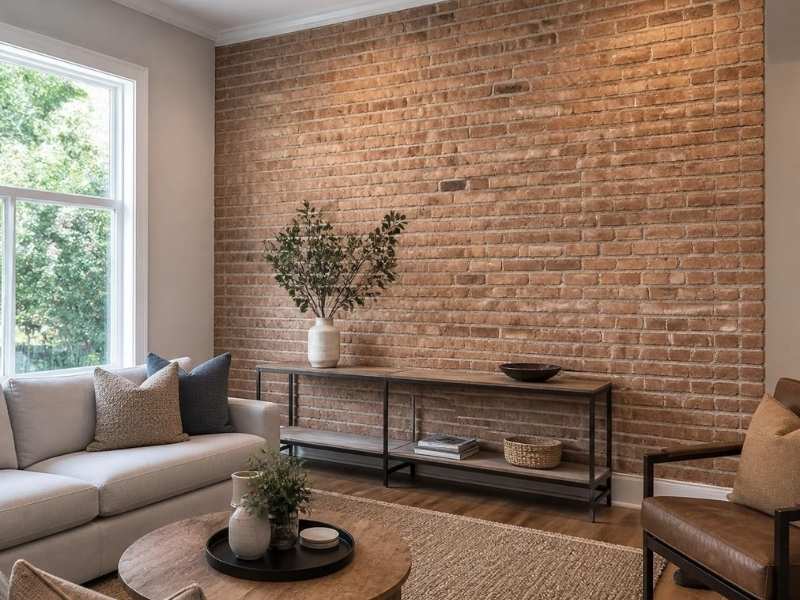
Full brick is heavy. It needs a footing and a ledge to sit on. In a house that’s already built, that rules it out for most walls. Thin brick solves the problem. It’s real brick sliced thin, so it sticks to a wall like tile and gives you the brick look without the weight. For a developer updating a home, that opens up spots full brick could never touch.
Thin brick works best where you want the brick look on a surface that can’t carry real masonry. That means interior walls, backsplashes, fireplace faces and quick exterior updates. It goes on fast, adds no footing and fits tight spaces. Pick the right spot and it reads as solid brick to almost anyone.
Why Thin Brick Fits a Renovation
Thin brick gives you real brick looks without the weight or the footing. That’s what makes it a renovation material.
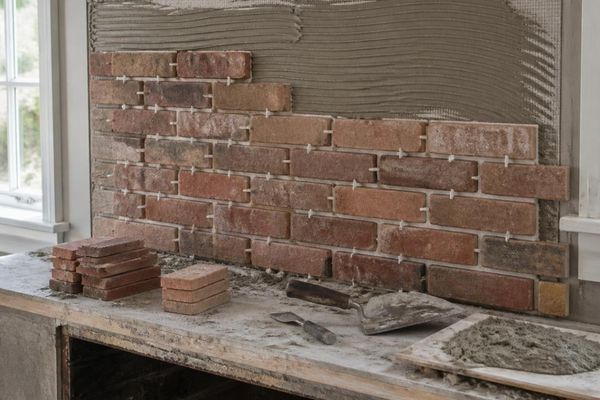
It’s fired clay brick, cut into thin slices about half an inch deep. It weighs far less than a full brick. That means it can go on interior walls, cabinets and other surfaces that could never hold real masonry. You bond it to a prepped surface, then grout the joints like tile.
No footing. No wall ledge. Less demo. For a home that’s already finished, that’s the whole appeal. Thin brick also comes in flat pieces and matching corner pieces, so an installer can wrap outside edges and keep the full-brick look at every turn.
Interior Accent Walls
An accent wall is the top use for thin brick indoors. One brick wall adds texture and warmth to a room fast.
Living rooms, dining rooms and entries all take well to a brick feature wall. So do home offices and the wall along a staircase. The trick is to pick one wall and stop there. A single brick face reads as a design choice. Four brick walls can feel like a basement. Color matters as much as placement, since a light whitewashed brick opens a room up while a dark red brick makes it feel cozy and closed in.
Installed over the right backing, thin brick sits nearly flush with the wall. It adds depth without eating floor space. That balance is why it sells so well in a remodel. Buyers walk in, see a brick wall and read the whole home as higher quality.
Kitchen Backsplashes and Feature Spots
Thin brick makes a warm backsplash with real texture. It fits kitchens going for a rustic or classic look.
Run it behind the counters and up behind the range. Wrap it around a range hood or across an island face. It gives a kitchen character that flat tile can’t match. In a rental or a flip, that character can lift the whole room.
One caution. A kitchen throws grease, steam and splashes at the wall. Seal the brick and the grout so you can wipe it clean. Skip the sealer and the joints stain fast. Keep a few spare brick pieces from the batch too, since a matching repair is easy while the same color is still on hand.
Fireplace Faces Without Heavy Demo
Thin brick can reface a fireplace without tearing out the old surround. It bonds right over the existing face.
Say a fireplace has dated tile or worn brick. Thin brick goes over it, so you skip a full demo. That saves time and keeps the mess down. The result looks like a solid brick fireplace at a fraction of the work.
One rule near a firebox. Use brick and mortar rated for heat, and follow the clearance the maker lists. A mason can tell you what’s safe for your setup. Cutting that corner is how a nice reface turns into a hazard. The same thin brick can carry up the chimney breast to the ceiling, which makes a short fireplace wall feel taller and more built-in.
Exterior Updates and Spots Full Brick Can’t Go
Outside, thin brick refreshes a facade or fills spots too tight for full brick. It gives the brick look with a slim profile.
Use it on an entry, a porch base or a band of wainscot along the front. It can wrap a post or a column where a full brick ledge was never built. On an exterior, though, the install has to handle weather. That means a proper moisture barrier and drainage behind the brick.
Get that detail right and the facade holds up for years. Get it wrong and water gets trapped behind the brick. On any outside job, have a pro set both the moisture system and the finish. It also helps to check that the thin brick you pick is rated for exterior use, since some lines are made for indoor walls only.
Frequently Asked Questions
What is thin brick?
Thin brick is real fired-clay brick cut into thin slices. Each piece is about half an inch deep. It installs like tile, bonded to a wall and grouted at the joints. It gives the look of full brick without the weight.
Does thin brick need a footing like full brick?
No. That’s the main reason it works in a renovation. Full brick needs a footing and a ledge to carry its weight. Thin brick bonds to the surface, so it adds almost no load.
Can thin brick go over drywall?
Yes, with the right prep. Most installers add a cement backer board or a bonding surface first. That gives the thin brick a solid base to grip. A mason can prep the wall so the brick holds for good.
Is thin brick durable enough for a kitchen or fireplace?
Yes, when it’s installed and sealed right. In a kitchen, seal the brick and grout so the grease wipes off. Near a firebox, use heat-rated brick and mortar. Both spots hold up well with the proper materials.
Does thin brick look fake up close?
A good thin brick looks like a full brick, even up close. It’s real clay fired, so the color and texture are genuine. The only giveaway is the cut edge, and trim pieces hide that at corners. A clean install reads as solid brick.
