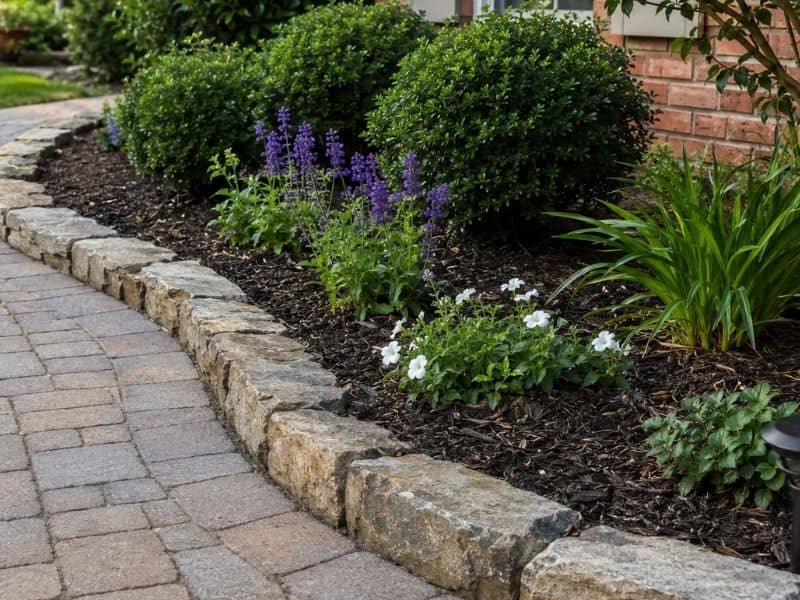
Stone edging is one of the easiest ways to give a yard a finished look. It marks the line between a walkway and the grass, or a flower bed and the lawn, without needing a fence or a wall. For homeowners, stone edging also holds up well against the area’s mix of rain, clay soil, and hot summers. Once it’s in place, it keeps mulch where it belongs and stops grass from creeping into planting beds. It also works with almost any yard shape, including the curved paths that many homes have now instead of straight, boxy layouts.
Choosing Stone Edging for Curved Walkways
A straight walkway is simple to edge. A curved one takes more thought. Small stones bend around a curve better than large slabs because they have more contact points along the ground. If the stones are too big, gaps show up on the outside of each curve, and the edge starts to look choppy instead of smooth.
Thickness matters too. Thin edging can shift after a heavy rain, and Auburn gets plenty of that. Thicker stones stay put and give the border a sturdy, grounded feel. Shape plays a role as well. Rounded or irregular stones tend to hide small gaps naturally, while square-cut stones need tighter spacing to avoid an uneven look.
Before picking anything, walk the path you plan to edge. Notice where it curves sharply and where it curves gently. A tight bend near a porch step needs smaller stones than a wide, sweeping curve across an open lawn.
Stone Edging Ideas for Residential Planting Beds
Planting beds around a home don’t need a heavy border to look defined. A single row of stones set into the soil is often enough to separate flowers or shrubs from the lawn. This keeps mowers from cutting into the bed and gives it a clean, intentional shape.
For beds near a front entrance, a slightly raised edge can add depth without taking over the view of the plants. In side yards or back corners, a flatter edge works fine since those areas usually get less attention. Some homeowners mix stone sizes within one bed, using larger pieces at the front corners and smaller ones along the sides. This small variation keeps the border from looking too uniform or store-bought.
Color matters here more than people expect. Warm gray or tan stones tend to blend with the red clay soil common around Auburn, while whiter stones stand out more and draw the eye. Either choice works. It just depends on whether you want the edging to stay quiet or become a visible feature.
Creating Smooth Curves With Stone Edging
A curve looks smooth when it’s planned before the first stone goes in. Marking the intended line with a garden hose or a can of spray paint gives a clear visual guide. It also lets you step back and check the shape from a distance, which is something you can’t do once stones are already placed.
Consistency matters more than perfection. A curve doesn’t need to be mathematically exact, but it should flow at a steady rate. Sudden tight turns next to long, lazy bends make a border look accidental rather than designed.
Stone selection affects this too. Pieces that vary too much in size can throw off the rhythm of a curve, since the eye naturally follows the top edge of the stones as a line. Picking stones that are close in size, even if they’re not identical, keeps that line steady from one end of the curve to the other.
Matching Stone Edging With Existing Landscape Features
Stone edging shouldn’t feel like it was dropped into the yard as an afterthought. It should relate to what’s already there. If a home has a brick exterior, edging in a similar warm tone often feels connected rather than random. If the yard already has a stone walkway or a rock garden, matching the general color family ties the whole space together, even if the stone types aren’t identical.
Scale is just as important as color. A large front yard can handle bigger, chunkier stones without feeling cluttered. A small courtyard or narrow side bed usually looks better with smaller, more delicate pieces. oversize edging in a tight space tends to overwhelm everything around it.
It also helps to think about how the edging will look from the street, not just up close. Some details that seem fine from three feet away disappear entirely from the sidewalk, so it’s worth checking both views before finishing the whole layout.
Maintaining Stone Edging Along Walkways and Beds
Stone edging isn’t something you install once and forget. Over time, soil shifts, mulch piles up, and stones can lean or slide out of line. A quick walk-through every few months catches these problems early, before the whole border starts to look messy.
Clearing soil and mulch that build up against the stones keeps the edge visible and sharp. Grass and weeds also like to creep along the base of stone edging, so pulling them back regularly stops them from hiding the line completely. If a section of stones has shifted after a storm, resetting it right away is much easier than fixing a border that’s drifted out of place for months.
Small fixes like these take only a few minutes, but they’re the difference between edging that looks sharp year-round and edging that slowly fades into the background.
Frequently Asked Questions
What is the best stone for curved landscape edging?
The best choice depends on the tightness of the curve, the look you want, and how long you need it to last. Smaller, rounded stones usually follow curves more smoothly than large, flat slabs, and denser stone types tend to hold their position longer.
Can stone edging follow a tight curve?
Yes, but it depends on the stones you use. Tighter curves need smaller stones with more flexible shapes. Large or heavily angled stones struggle to follow a sharp bend without leaving visible gaps.
How do you keep stone edging from shifting?
Proper placement matters most. Setting stones into firm, level ground and packing soil tightly around each piece reduces movement. Drainage also plays a role, since soggy soil under the edging can cause shifting over time.
Is stone edging suitable for both walkways and planting beds?
Yes. The same basic idea, using stones to mark a clear boundary, works in both settings. Along a walkway, it keeps grass off the path. Around a bed, it keeps soil and mulch contained.
How often should stone edging be maintained?
A check every few months is usually enough for most yards. Look for stones that have shifted, gaps that have opened up, and mulch or soil that’s covering the edge, then handle small issues before they turn into bigger ones.
