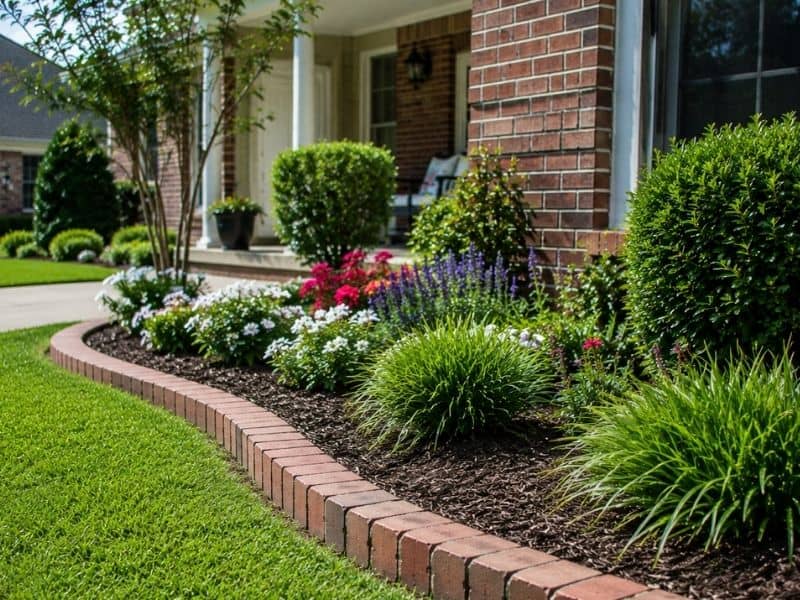
A quick construction survey of most front yards shows the same problem: grass creeping into flower beds, mulch spilling onto the lawn, and no clear line between one section and the next. Brick edging fixes that. It gives a front yard a clean border between grass and planting areas, and it holds that line season after season. For homeowners, brick edging is a simple way to make a front yard look more put together without changing the whole layout.
Using Brick Edging to Separate Lawn From Planting Areas
A front yard usually has a few different zones: the lawn, a flower bed near the porch, maybe a mulched area under a tree. Without a border, those zones blend together. Grass creeps into the mulch. Mulch washes onto the sidewalk after a storm. Brick edging draws a line that keeps each section where it belongs.
This isn’t about adding a decorative feature for its own sake. It’s about organization. A row of edging along a flower bed tells the eye exactly where the lawn stops, which makes the whole yard read as more deliberate. Even a small front yard looks bigger and more organized once the sections are clearly marked.
Planning Brick Edging Around Existing Front Yard Features
Most front yards already have fixed points: a mailbox, a tree, a walkway, maybe a porch step that juts out into the lawn. Edging has to work around these instead of ignoring them.
A mailbox post is a good example. Edging can curve around the base to create a small planting ring, which turns an awkward patch of grass into something intentional. Around trees, the edging usually follows the drip line or a slightly wider circle, giving roots room while still marking the boundary clearly.
Driveways and sidewalks are trickier because the edging often needs to run parallel to a straight hardscape edge. Keep a consistent gap between the brick line and the concrete, so the space between them doesn’t look like an accident. For irregular lawn shapes, the goal is to let the edging follow the shape that already exists rather than forcing a new one. A front yard with a bowed section near the street doesn’t need to be squared off. The edging can simply trace that curve.
Picking Brick Colors and Patterns for Front Yard Appeal
Color makes a bigger difference than most people expect. A brick that closely matches the house creates a subtle, blended look. A brick with more contrast, like a lighter tan against a red-brick home, makes the border stand out as its own feature. Neither is wrong. It comes down to whether the goal is a quiet accent or a visible line.
Size and orientation matter too. Standard bricks laid flat give a low, understated edge. Bricks turned on their side or set at a diagonal add a bit of texture without much extra cost. A simple repeating pattern, like alternating two brick tones every few feet, can add interest along a longer bed. The key word there is simple. A front yard border isn’t the place for anything too busy. It should support the landscaping, not compete with it.
Making Brick Edging Work With Different Lawn Shapes
Straight lawns are the easiest case. Set a string line, keep the bricks tight against each other, and the result looks clean almost automatically. Curved lawns take more planning. A gentle curve works with standard bricks angled slightly against one another, and consistent spacing is what makes the curve look smooth from the street rather than choppy up close.
Irregular shapes, like a lawn that narrows near a side gate or widens around a corner bed, need the most attention. The trick is keeping the spacing between bricks even throughout, even as the direction of the line changes. Uneven gaps are what make a curve look accidental instead of planned. From the sidewalk, a well-laid curve should look like it was always meant to be there.
Keeping Brick Edging Looking Clean Through the Seasons
Edging needs some upkeep to stay sharp, though it’s not a heavy job. Grass along the border tends to creep over the bricks during the growing season, so trimming that back every few weeks keeps the line visible. Leaves and debris pile up along any raised edge, especially in fall, and clearing them out keeps mulch beds from looking neglected.
It’s also worth walking the border a couple times a year to check for bricks that have shifted or sunk slightly out of line. Small adjustments are easy to fix by hand. Refreshing the mulch or ground cover inside the bed every season also helps, since faded or thin mulch makes even a perfectly straight edge look tired. None of this takes much time, but it’s the difference between edging that looks sharp year-round and edging that slowly fades into the background.
Frequently Asked Questions
What is brick edging used for in a front yard?
It separates the lawn from flower beds, mulch areas, and other landscaped sections. This gives the yard a more defined, organized look instead of one area blending into the next.
Can brick edging improve front yard curb appeal?
Yes. A clean, consistent border makes planting areas look more intentional and can complement the home’s existing exterior, especially when the brick tone is chosen to match or contrast with the house.
Can brick edging follow an uneven lawn border?
Yes. Brick edging can trace gradual curves and irregular boundaries as long as the spacing between bricks stays consistent, which keeps the line looking smooth rather than choppy.
What brick color works best for landscape edging?
The best choice depends on the home’s exterior and existing hardscape. Matching tones create a blended look, while contrasting tones make the border stand out as its own feature.
How do you keep brick edging neat?
Clear away leaves and debris regularly, trim back grass that grows over the border, and check every so often for bricks that have shifted or sunk out of alignment.
